PS-W11 / Roofs
Fast drying PU roof coating
Water-based one-component PU membrane for technically suitable roofs where a short implementation window, early rain resistance and low emissions are important. A quick system route with preparation, primer, details and multiple controlled layers.
Project specificExposed, UV and weather exposed
01
02
03
04
INDICATIVE SYSTEM VISUAL — PROJECT CONSTRUCTION MAY VARYPolyShield performs this
Fast drying PU roof coating from approximately 50 m²
Finish a suitable roof waterproof in a short renovation window with a water-based, very low-VOC PU system.
- 01Inspect roof structure, moisture and details
- 02Cleaning and repairing weak areas
- 03Apply primer and detail reinforcement
- 04Waterproof membrane delivered in a controlled manner
From damage picture to solution
Problem, cause and effect first visible.
- Aging due to UV and weather stress
- Vulnerable seams, upstands and penetrations
- A limited implementation window between use and weather risk
Delay can cause details and roof surfaces to age further, increasing the scope of repairs and the risk of consequential damage.
Substrate control, suitable primer, reinforced details and a quickly overcoatable PU membrane structure; product speed never replaces technical preparation.
Business benefits
The value is not just in the new layer.
Short lead time
Under appropriate circumstances, a complete multi-layer construction can be planned in one day.
Early rain resistance
The membrane can quickly build up resistance to rain according to product specifications; temperature, moisture and layer thickness remain decisive.
Very low VOC
The water-based route limits solvent loading during application.
White system choice
A white version can support sun reflection without promising fixed energy savings.
RISK OF DELAY
A minor maintenance issue can progress to wet zones, detailed repair or replacement; suitability must therefore be determined in a timely manner.
First have the size, cause, accessibility and desired planning assessed. We then compare repair, renovation and, where necessary, replacement without selling a standard solution in advance.
Have project assessed →Real projects, not stock evidence
Conducted evidence in system selection
View initial situation, preparation, details and results. Project details are only mentioned when they are available in the file.
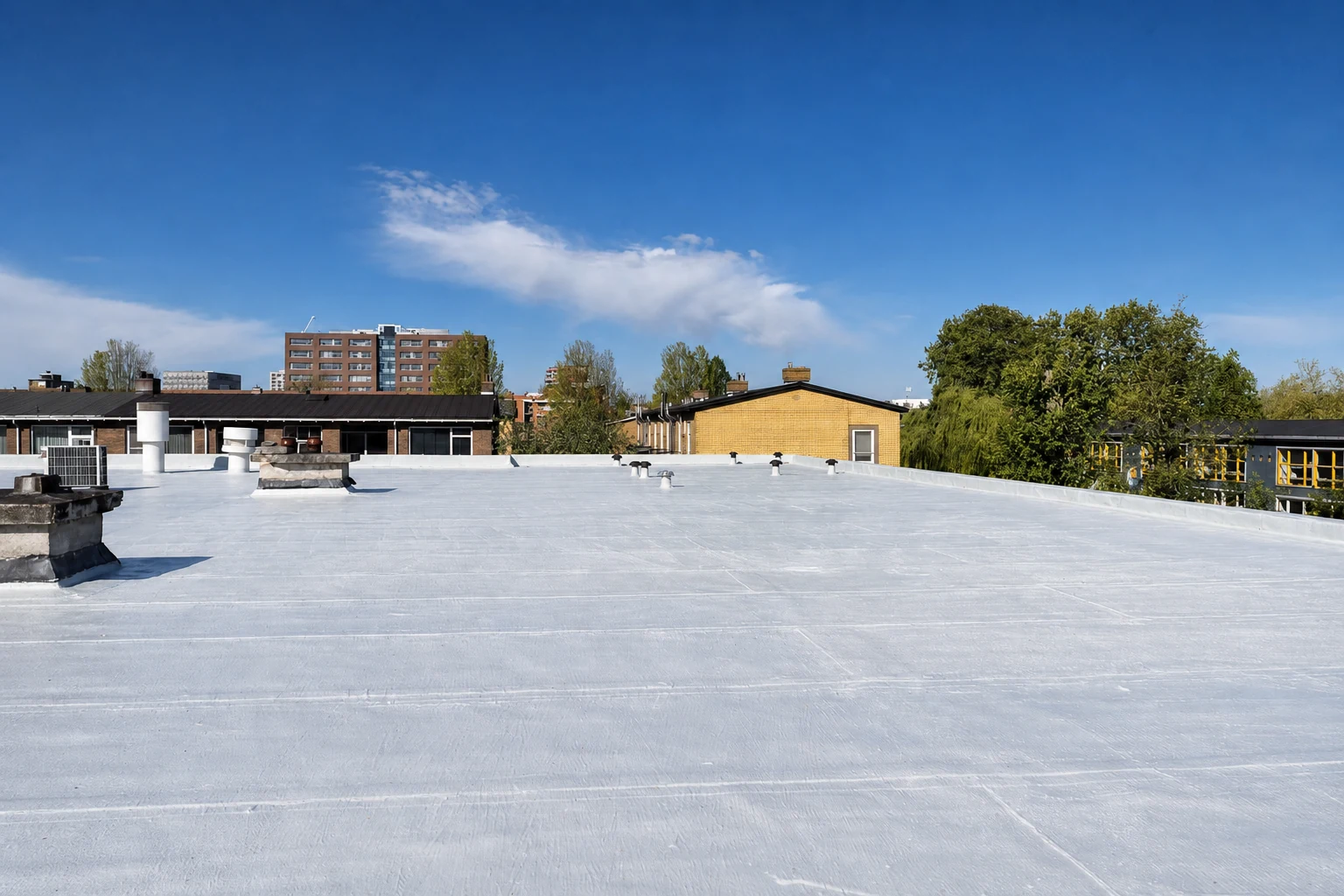 01 / Location confidentialPlanned roof renovation of school building
Approximately 700 m² of outdated bituminous roofing with strong crackle formation, systematically renovated with primer, reinforced details and two layers of white 2K polyurea.
Open project file →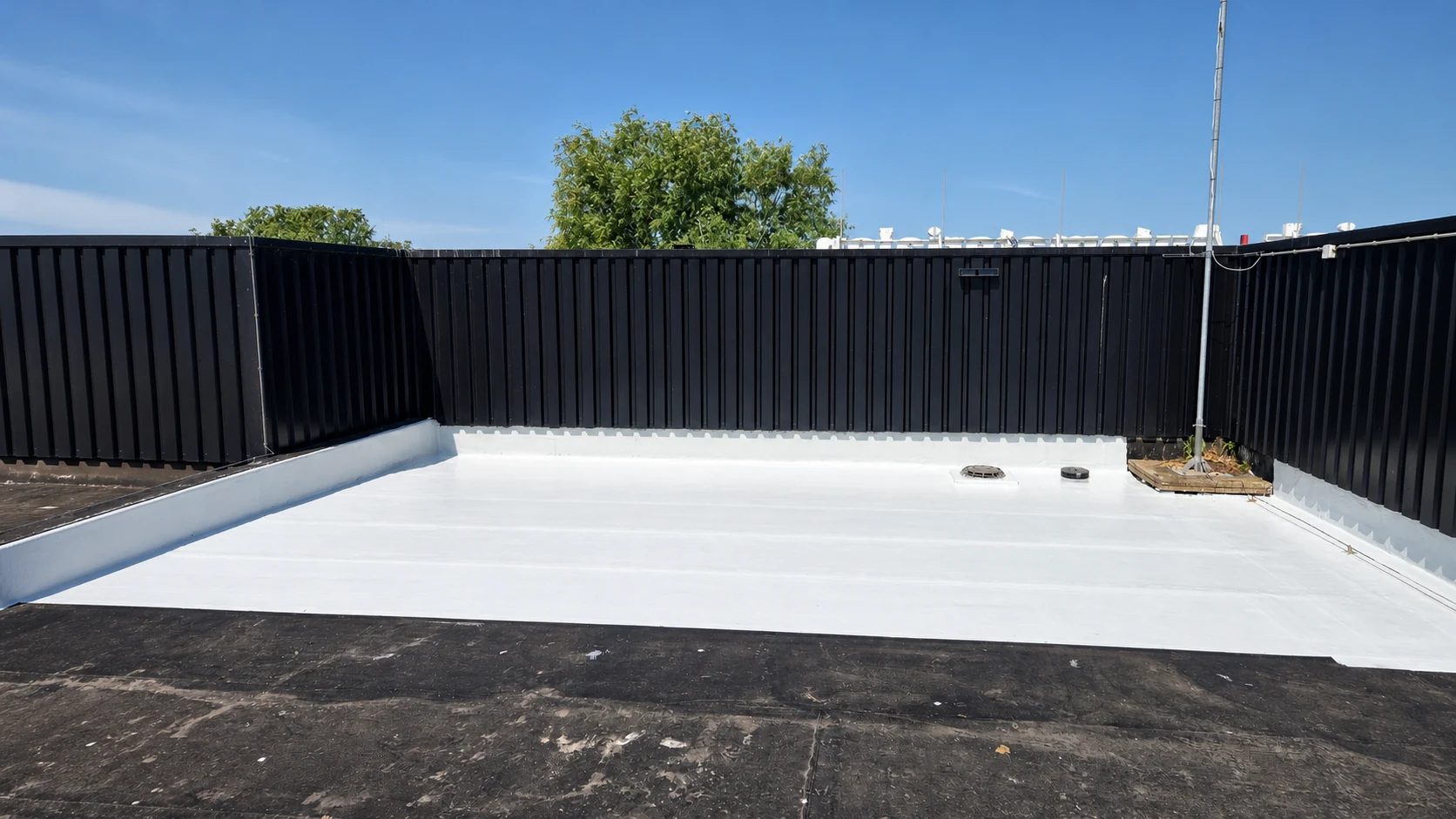 02 / MiddelburgEmergency repair of production roof with 2K polyurea
Approximately 150 m² of a commercial roof with multiple leaks has been purposefully renovated. The urgent system approach protects the valuable production equipment under the roof against further water damage.
Open project file →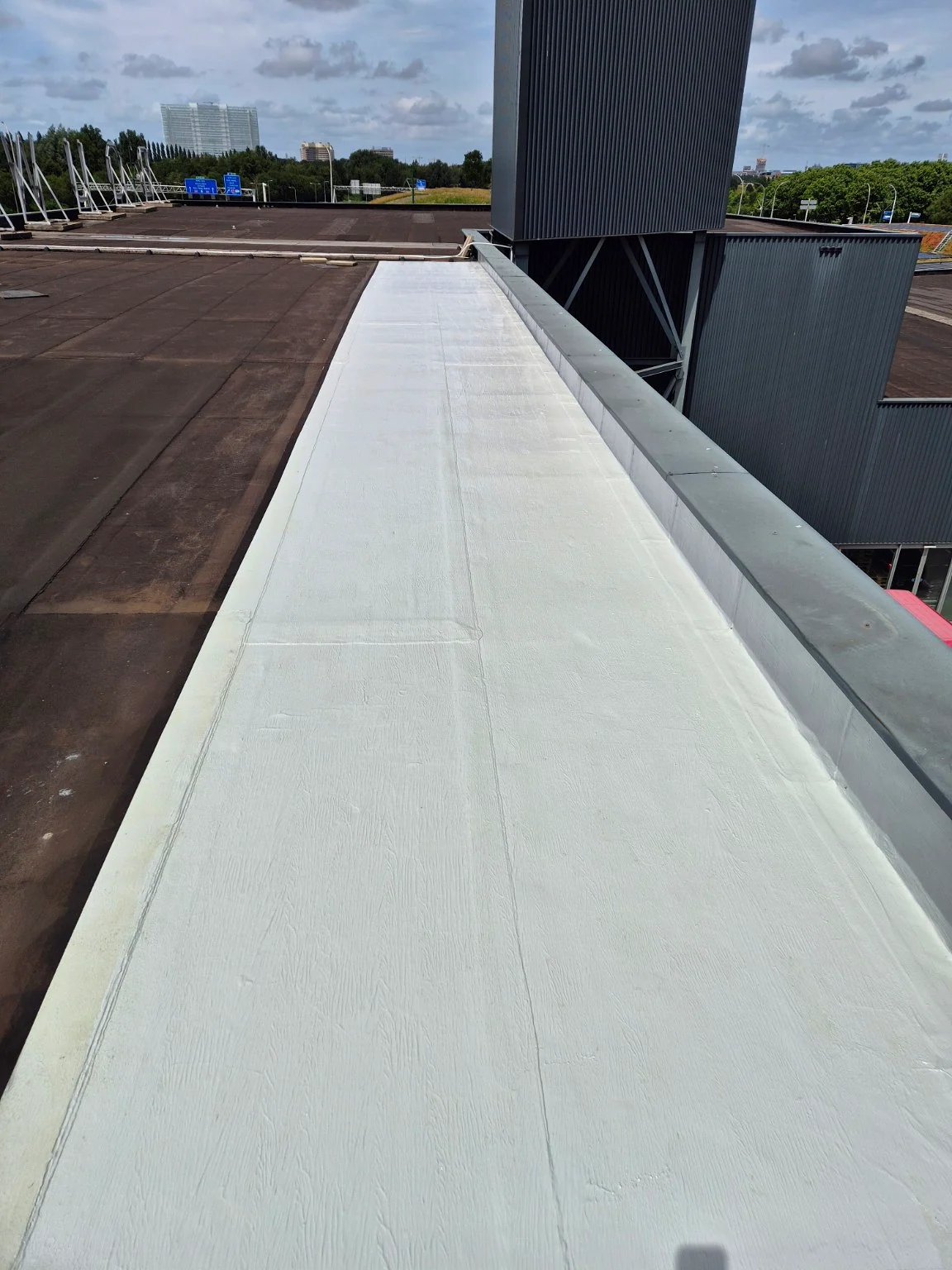 03 / THE HAGUELocal 2K polyurea roof renovation
Op een bedrijfsdak van circa 350 m² zijn meerdere lekkages doelgericht verholpen. De geselecteerde zones zijn gereinigd en vervolgens met primer, geotextiel en een vloeibare 2K-waterdichting behandeld.
Open project file →Layer by layer
A complete structure, no loose coating.
The structure shown makes the function of each layer understandable. Primer, reinforcement and consumption are only definitively specified after subsurface research.
- 01Prepared roof substrate
Fixed, clean, repaired and technically suitable
- 02Surface-specific primer
Controlling adhesion, suction and compatibility
- 03Detail enhancement
Seams, cracks, bilges, drains and transitions
- 04Fast PU membrane layers
Water-based white waterproofing in controlled work processes
System profile
What this direction is rated for.
- Grotere particuliere daken via de afzonderlijke route vanaf circa 50 m²
- Commercial roofs after checking project fit and technical added value
- Walkable roof terraces and maintenance roofs
- Concrete and cement-bound roofs
- Metal roof surfaces
- Maintenance over suitable existing liquid membranes
- Bituminous membranes with mineral finish
- Water based and very low VOC according to source product
- Touch dry and can be quickly overcoated under prescribed conditions
- Early rain resistance within the appropriate application window
- White variant with documented Cool Roof properties
- Elastic and crack-bridging
- High resistance to standing water within the approved structure
- Concrete and cement-bound roofs
- Bituminous membranes with mineral finish
- Metal
- Technically suitable existing liquid membranes
- PU foam
Application boundaries
Where this system fits primarily, conditionally or non-standard.
The classification helps with the initial selection. Substrate, load, detailing and current system documentation remain decisive.
- Wet or unstable surface
- Unknown layers without test adhesion
- Structural defect without repair
- Undocumented product combination
01 / Inspect
We want to know this first.
- Type and condition of the existing roof layer
- Residual moisture and dryness of the substrate
- Adhesion, suction and compatibility
- Slope and zones with stagnant water
- Seams, cracks, drains and upstands
- Weather window, temperature and humidity
02 / Limit
When we don't execute immediately.
- Do not include wet insulation or saturated substrate
- Early rain resistance is not a universal guarantee
- Same-day execution only applies with suitable conditions and system structure
- Do not equate with the premium 2K polyurea system
- Determine primer and detail treatment project-specifically
03 / Substantiate
Which must be demonstrable.
- Check current TDS, DoP and system sheet before offering
- Record consumption and number of layers per surface
- Link Cool Roof values exclusively to the white documented variant
- Register application conditions and recoating times per work area
Technical proof
Performance is system and structure specific.
The statuses below are deliberately reserved. A proof is only shown as proven after the current document, the system variant and the intended use have been checked.
ETA/EAD
An ETA applies to the described system kit and its intended use. Document number and current system variant are checked before publication.
CE and declaration of performance
CE and DoP describe declared product performance; they are not a blanket endorsement of every roofing project.
BROOF classification
Only claimable for the exact tested roof structure, substrate, layer thickness and the stated test suffix, for example BROOF(t1).
Waterproofing
Test performance and application conditions must correspond to the selected membrane variant and project structure.
Crack bridging and movement
Class, temperature and layer thickness are taken from the current technical documentation.
VOC and environmental documentation
VOC, EPD and other environmental claims are only published with a current, traceable source.
From system direction to offering
Four pieces of information that really determine the quotation.
Material, condition, moisture, adhesion and existing layers.
Edges, bilges, drains, penetrations, seams and connections.
Water, UV, movement, traffic, use and operating conditions.
Accessibility, phasing, safety, planning and weather window.
Fast track alternative
Run quickly without skipping system build.
This water-based one-component PU is not a simplified version of 2K polyurea. It is a separate technology for technically suitable roofs where a compact weather and renovation window is important.
PolyShield retains the same working method: roof inspection, cleaning, repair, surface-specific primer, detail reinforcement, controlled consumption and delivery control. Fast drying does not mean that preparation is unnecessary.
Six distinctive benefits
Practical for medium-sized roofs and carefully defined.
Short execution window
Under prescribed conditions, the source variant is touch dry around one hour and can be reapplied around two hours. As a result, a multi-layer roof route can sometimes be completed within one working day.
Early rain resistance
The source variant mentions resistance to early rain from approximately thirty minutes. This remains dependent on the substrate, layer thickness, temperature, humidity and actual weather load.
Water-based and very low VOC
Interesting for homes and used buildings where odor, emissions and processing nuisance must be consciously limited.
White Cool Roof Route
For the white source variant, initial values of SR 0.82, emissivity 0.96 and SRI 104 are documented. These are product measurements, not a guarantee of fixed energy savings in the home.
Walkable roofs
The technology is intended for suitable walkable roof surfaces and combines elasticity with mechanical resistance within the prescribed structure.
Resistance to standing water
The source mentions high resistance to puddle formation. Slope, drains and detailing nevertheless remain part of the roof assessment.
When this route becomes interesting
Especially when planning, weather risk and limited nuisance come together.
Larger garages, extensions, detached outbuildings and roof terraces where a professional system approach is economically feasible.
Offices, shops, practice spaces and business objects where the working window, the surface or the connection with a broader renovation justifies a complete system route.
Only after compatibility, adhesion, moisture condition and necessary primer have been determined.
Where waterproofing, occasional walkability and a reflective surface fit within one system question.
Positioning next to 2K polyurea
Two high-quality routes, with a different technical profile.
Premium 2K polyurea remains the preferred route for larger business renovations, higher mechanical requirements and projects where a complete two-component construction is distinctive.
Fast 1K PU is attractive for suitable medium-sized roofs where water-based processing, very low VOC, fast recoating times and early rain risk are decisive.
Compare with premium 2K polyurea →View the private route from 50 m² →Frequently asked questions
Technical clarity before application.
Is this system directly suitable for every surface mentioned?
No. The substrate must fall within the approved system scope and is checked for cohesion, moisture, contamination, movement and adhesion. The correct preparation and primer are then recorded.
Is the layer structure shown always the same?
The functions remain recognizable, but primer, reinforcement, number of layers and consumption may differ per substrate and load. The final structure is stated in the project specification.
Can the system be installed over existing waterproofing?
Only when material, mounting and condition are known and a compatible structure can be demonstrated. For unknown membranes or coatings, we first carry out identification and test adhesion.
What lifespan or warranty applies?
Technical ratings and expected useful lives are for specifically rated systems. The project guarantee also depends on the surface, scope, implementation, maintenance and written agreements.
What is the first step?
A project screening and inspection. We record construction, surface, damage picture, water load, details, accessibility and desired planning.
Related expertise
From waterproofing system to application, evidence and project route.
These next steps are linked to application, substrate, risk and decision phase. This way you navigate from general information to technology, evidence and a useful project route.
Tool
PolyShield System Configurator
Translate building part, subsurface, priority and planning into a transparent first system direction.
View this route →KnowledgeWhy use primer for roof coating?
Primer selection depends on the surface, preparation, moisture and adhesion route.
View this route →TechnologyPrimers and adhesive layers
The project-specific connection between prepared substrate and subsequent layers.
View this route →ToolPortfolio Scan and Decision Center
Rank multiple assets by urgency, consequential damage, continuity and file level.
View this route →TechnologyPremium cold applied 2K polyurea
Complete quick waterproofing route with primer, details and UV resistant membrane.
View this route →Target groupProperty owners and managers
From object risk to portfolio priority, decision file and phased implementation.
View this route →