Crack formation
Shrinkage, settlement, thermal movement, load or corrosion can each cause a different crack pattern.
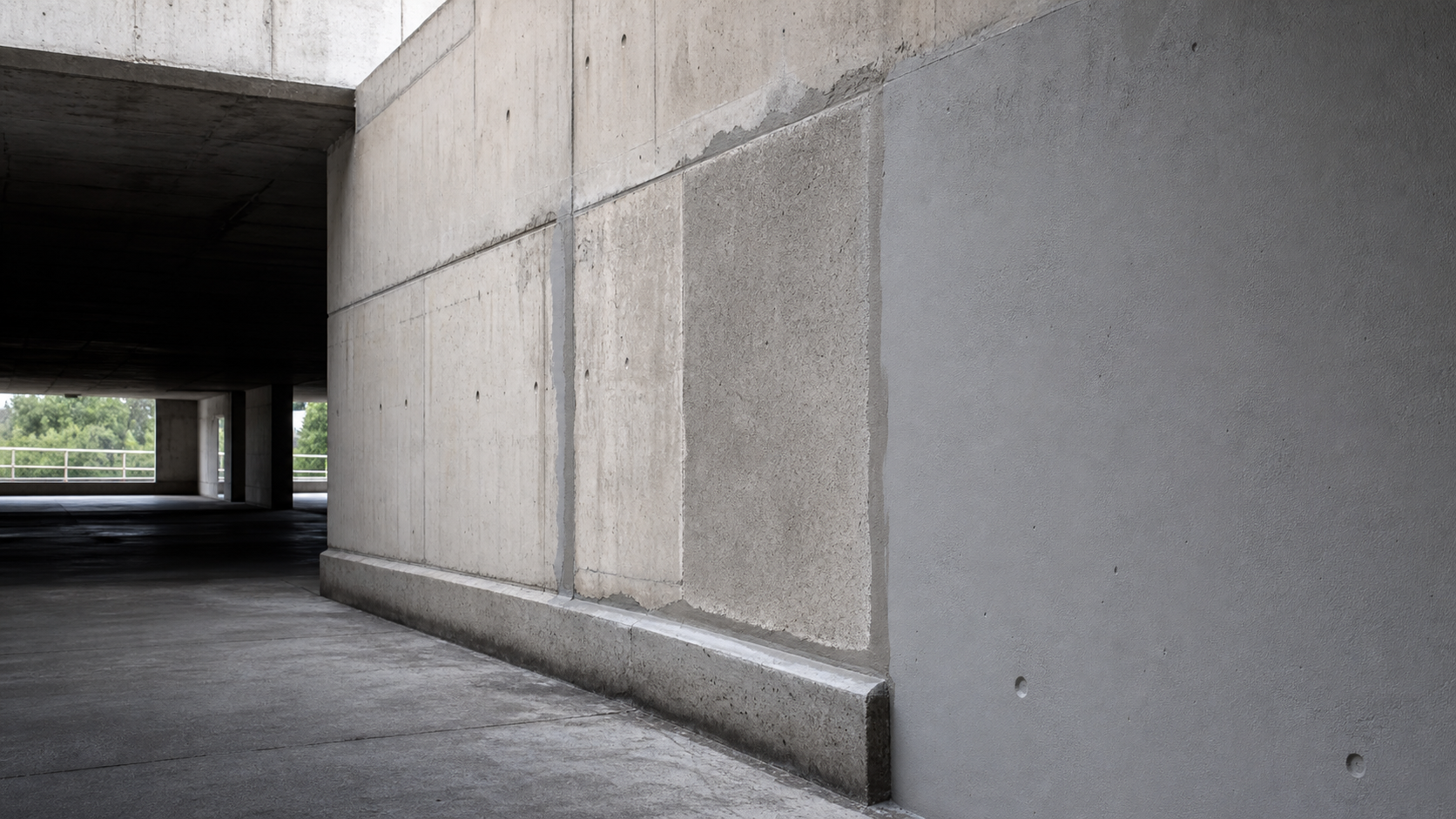
PolyShield Concrete
For parking garages, basements, elevator pits, commercial buildings and civil structures. We link visible damage repair to the actual cause, water load and desired residual lifespan.
Cause before finishing
A crack, trace of rust or leakage tells you that something is happening, but not automatically why. Without distinguishing between movement, corrosion, water pressure, chloride load and superficial damage, there is a risk that only the visible symptom will be eliminated.
Our order:investigate → delineate → restore → protect → check
Four technical disciplines
The disciplines can be separate or combined parts of a project.
Remove affected or loose concrete, assess and treat reinforcement and repair the profile with a suitable repair mortar.
View direction ↗02Crack type · movement · waterFirst classify cracks according to cause, movement and water load and then seal, bridge or have them injected.
View direction ↗03Water pressure · joints · detailsWaterproofing of basements, lift wells and technical structures based on the actual positive or negative water load.
View direction ↗04Climate · chemistry · lifespanProtective systems against moisture, carbonation, chlorides, chemicals, freeze-thaw and operational stress.
View direction ↗Damage signals
Shrinkage, settlement, thermal movement, load or corrosion can each cause a different crack pattern.
Rusting rebar expands and can push away cover; closing alone does not stop the cause.
Water can enter through cracks, construction joints, penetrations, bilges or porous zones.
May indicate active corrosion, insufficient coverage, chlorides or long-term moisture exposure.
Makes water transport visible, but does not say where the leakage route starts without further research.
Request demarcation and removal until a load-bearing surface has been achieved.
From symptom to system direction
That is why we compare observation, possible cause, required control and possible system direction. Structural assessment and specialist laboratory testing remain separate disciplines where necessary.
Start technical pre-selection →Research and selection framework
Function of the element, load, accessibility and available drawings or previous studies.
Carbonation, chlorides, moisture, chemical attack, freeze-thaw, movement or mechanical impact.
Location, corrosion pattern and concrete cover determine the repair and protection needs.
Width, depth, activity, pattern and water transport are assessed separately.
Positive or negative water pressure determines which solutions are technically possible and sustainable.
Climate, traffic, chemicals, cleaning and desired residual life determine the choice of system.
Functional recovery building
The exact mortar, layer thickness and protection class will follow from research. The functional sequence remains recognizable: remove damage, treat reinforcement, repair profile and protect the surface appropriately.
View our quality approach →Object types
Traffic, chlorides, cracks, joints and leakage to underlying zones.
↗02Soil moisture, water pressure, pouring seams, bilges and limited accessibility.
↗03Active leaks, penetrations, joints and permanent technical installations.
↗04Water, chlorides, climate, detail and demonstrable project specifications.
↗05Chemical load, impact, cleaning and protection of critical zones.
↗06Balconies, galleries, facade concrete, technical rooms and planned maintenance.
↗From damage picture to file
Each implementation phase only follows after the previous subsurface or recovery zone has been cleared.
Collect construction function, damage history, leaks, usage and available reports.
Investigate damage, moisture, cracks, loose zones and, where necessary, carbonation or chlorides.
Work out repair areas, crack details, waterproofing, surface protection and control points.
Remove affected concrete, treat reinforcement, detail cracks and restore profile.
Apply the selected system within the required substrate and climate conditions.
Record recovery zones, material consumption, layer structure, details, deviations and maintenance.
Clear responsibilities
Load-bearing capacity, stability and structural cracks are assessed by the responsible structural engineer.
If there is uncertainty about damage, sampling or laboratory testing may be necessary.
Water route, pressure and accessibility determine whether injection, drainage or a waterproofing system is appropriate.
Without substance, concentration, temperature and contact time, resistance cannot be specified responsibly.
Initial technical assessment
Share object type, damage picture, leak history, global size, accessibility and desired planning. We make it visible which data is missing and whether inspection, investigation or a targeted recovery recording is necessary.